


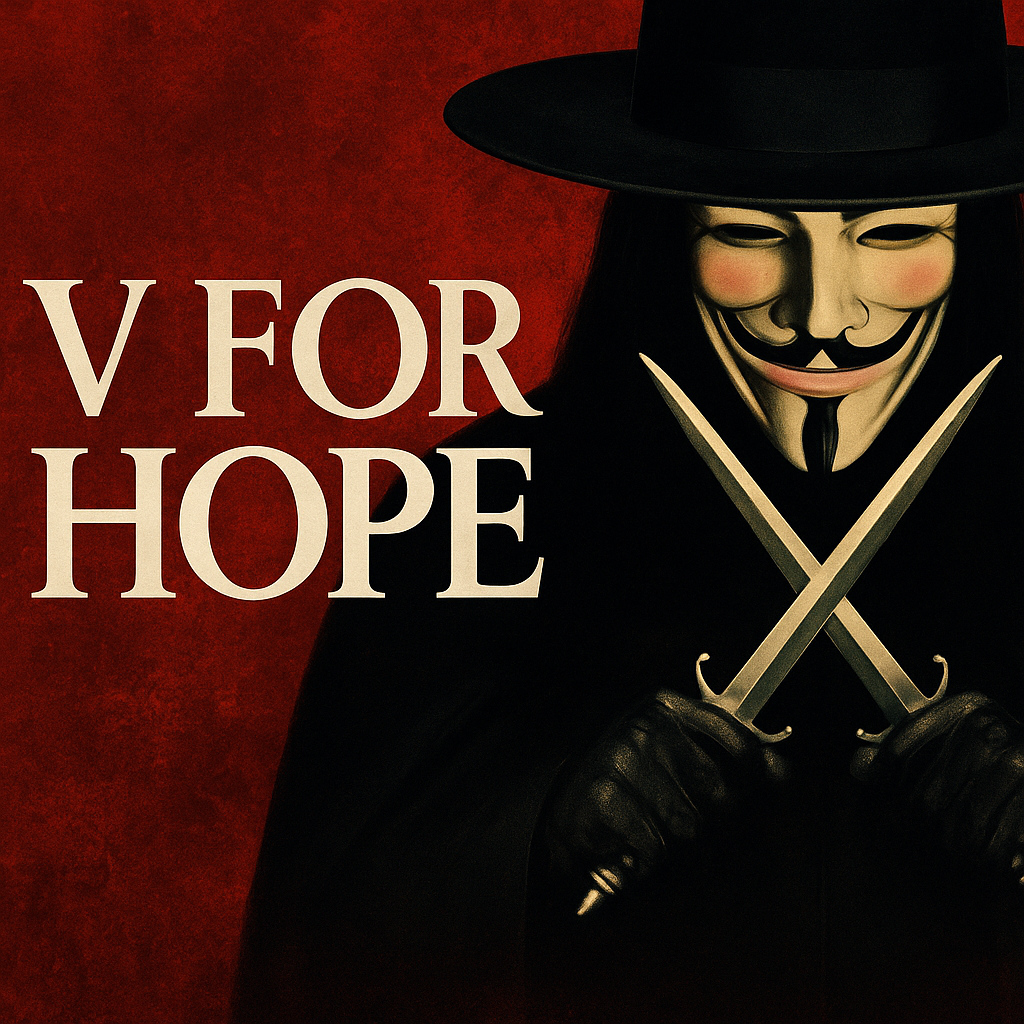
It’s been twenty years since V for Vendetta warned us what happens when fear replaces freedom—and we’ve learned nothing. In our panic, we elected Trump and Biden not out of hope, but out of fear. Both men—different in tone, identical in effect—embodied the same traits that defined Norsefire, the authoritarian regime from V for Vendetta: control through fear, obedience through manipulation, and the quiet surrender of liberty disguised as safety. We didn’t resist tyranny; we voted for our preferred version of it.
“There are of course those who do not want us to speak.” The line could have been written for our time. Those in power—whether draped in red or blue—fear free speech because truth threatens their control. Under Trump, the Justice Department secretly subpoenaed journalists’ communications, reporters were harassed, and peaceful protesters were surveilled, kettled, and gassed in the streets for daring to speak. Under Biden, the same machinery was refined into something quieter but no less sinister: the FBI monitoring parents at school board meetings, Catholic congregants labeled as “radical extremists,” and online speech flagged as “misinformation” for deletion. Norsefire used truncheons and prisons to silence dissent; America uses bureaucracy, surveillance, and social pressure. The result is the same—fearful citizens who learn to whisper when they once spoke freely.
“There is something terribly wrong with this country… cruelty and injustice, intolerance and oppression.” V for Vendetta made clear that authoritarianism isn’t born from a single villain—it’s the natural consequence of a society that stops questioning power. Under Trump, cruelty became a political strategy: family separations at the border, ICE raids at dawn, federal agents dragging protesters off the streets, and a “Constitution-Lite Zone” where surveillance replaced rights. Under Biden, the tactics evolved but the system endured. The PATRIOT Act still justifies mass spying, border emergency powers remain in force, and billions now flow to “counter-extremism” programs that treat ordinary citizens—parents, believers, dissenters—as potential threats. FISA 702 spying continues, largely unchecked. Both men expanded the same machine. Only the operators changed—the machinery of control never stopped running.
“You now have censors and systems of surveillance coercing your conformity.” That line strikes at the heart of what America has quietly become. Under Trump, whistleblowers were hunted, dissenters targeted, and entire agencies turned inward on their own people. DHS built surveillance programs to track protesters, and petty political vengeance drove absurd crusades like the attempted TikTok ban—policy by resentment, not reason. Under Biden, the same machinery was refined and sanitized. The FBI and DHS now operate vast “anti-extremism” dragnets, where parents and Catholics are flagged for ideology, peaceful antiwar and environmental protests are logged as potential threats, and private tech companies are enlisted to quietly suppress disfavored speech. Metadata flows endlessly into government archives, building a digital dossier on nearly everyone. This is Norsefire creeping in—not with uniforms and slogans, but through the soft tyranny of paperwork, algorithms, and administrative inertia. The boot no longer stomps on your face; it simply audits you into silence.
“Fear got the best of you… war, terror, disease… corrupt your reason.” Fear has always been the favorite tool of tyrants. It doesn’t need to convince—it only needs to paralyze. Under Trump, fear was the governing language: immigrant caravans portrayed as invading armies, Antifa painted as a domestic insurgency, “American carnage” invoked to justify iron-fisted control. Even COVID became a stage prop for executive power, complete with National Guard deployments and emergency decrees that blurred the line between protection and domination. Under Biden, the script changed but the plot remained. Fear of “Ultra-MAGA extremism,” “threats to democracy,” and a conveniently inflated domestic terrorism narrative kept the public anxious and compliant. COVID was stretched into a years-long pretext for expanded government authority, while January 6 became a blank check for surveillance, censorship, and limitless counterterror funding. Both sides learned the same lesson Norsefire did—that terrified people will accept any chain as long as it’s sold as safety. Fear didn’t just cow the people; it trained them to beg for their own restraint.
“He promised you order, he promised you peace… all he demanded in return was your silent, obedient consent.” That is the quiet pact both parties made with the people. Authoritarianism in America didn’t march in waving flags—it arrived politely, wrapped in patriotism or compassion, asking only that you obey your side. Under Trump, obedience meant personal loyalty to the man himself. Every criticism of his excesses was painted as betrayal. Supporters excused cruelty, corruption, and power grabs because they feared the alternative—a victory for “the enemy.” Under Biden, obedience was redirected toward institutions, not individuals. Citizens were told to “trust the experts,” “follow the science,” and accept censorship and surveillance as the cost of stability. His followers forgave the same abuses they once condemned, because this time it was their tribe wielding the whip. Fear made it easy—fear of Trump, fear of Biden, fear of chaos, fear of the other team. In both cases, Americans traded freedom for the comfort of belonging, blind to the truth that tyranny doesn’t need to conquer a divided people; it only needs to convince each half to silence itself for the sake of its colors—red or blue.
“There are those more responsible than others… but again truth be told, if you're looking for the guilty, you need only look into a mirror.” This is the most brutal truth V for Vendetta offers—and the one Americans still refuse to face. Authoritarianism is not something rulers impose; it’s something the people permit. Trump and Biden didn’t steal our liberty in the night—we handed it to them in broad daylight. We gave it away because hating the other side felt righteous. We gave it away because comfort was easier than courage, and safety sounded nobler than responsibility. We gave it away because fearmongering worked, because we wanted someone strong to punish our enemies, because obedience masqueraded as patriotism. Every time we said “if it keeps us safe,” we tightened the chains ourselves. Both parties exploited that weakness, each using fear to justify the same abuses we once swore we’d never tolerate. The guilty are not only those who rule, but those who traded freedom for the illusion of peace—and applauded while doing it.
“I know why you did it. I know you were afraid.” Fear is the oldest and most reliable political weapon—and America has been drowning in it for years. Under Trump, fear was the rallying cry: immigrants portrayed as invaders, caravans as armies, Antifa as terrorists, Muslims and Chinese citizens as existential threats, and political opponents as traitors to be crushed. Every speech, every tweet, every headline screamed the same message: Only I can protect you. Under Biden, the target shifted but the tactic stayed the same. Fear became moralized, dressed in the language of safety and decency. COVID panic justified mandates and censorship; “misinformation” became a reason to silence debate; parents, Catholics, and conservatives were recast as “domestic extremists.” Americans were taught to fear not foreign enemies but their neighbors, their churches, and their own voices. Trump’s fear divided the nation into enemies. Biden’s fear turned the nation against itself. Both corrupted reason and conscience in exactly the way V warned: when fear rules, truth dies, and obedience becomes the highest virtue.
“Fear got the best of you, and in your panic you turned to the now High Chancellor, Adam Sutler. He promised you order, he promised you peace, and all he demanded in return was your silent, obedient consent.” This is how free societies surrender—not with a bang, but with applause. When fear takes root, reason dies, and people trade liberty for the illusion of control. In V for Vendetta, the citizens turned to one man, Adam Sutler. In America, we turned to an idea—submission itself—and gave it two faces. Trump and Biden became the personifications of that same obedience: one embodying power wrapped in populism, the other control disguised as compassion. Each promised order, each promised peace, and each demanded silence. Trump’s tyranny wears bravado; Biden’s wore bureaucracy. Both sides offered protection from chaos, so long as we consented to be ruled by it. Instead of rejecting Sutler, we built two of him—red and blue—and convinced ourselves that choosing between them was freedom. But it was never freedom. It was fear masquerading as stability, and obedience masquerading as virtue—the slow, willing extinction of a people too afraid to be free.
“Last night I sought to end that silence.” V destroyed a building to wake a nation, but we don’t need explosions to reclaim our freedom. The Old Bailey was only a symbol—the real target was apathy, the quiet consent that lets tyranny grow. We can end that same silence not with bombs, but with ballots. We don’t have to burn a parliament to remind the world of fairness, justice, and freedom; we only have to remember that those ideals live or die in every choice we make.
“So if you've seen nothing, if the crimes of this government remain unknown to you then I would suggest you allow the fifth of November to pass unmarked.” But if you do see what I see—if you feel the weight of what we’ve lost and still believe in what we could be—then stand beside me not with anger, but with hope. We don’t need to gather outside Parliament or light the sky with fire. A year from now, we can gather in something far more powerful: the polling place. There, with a simple mark, we can defy the politics of fear that have divided and controlled us. We can choose principle over panic, compassion over cruelty, and truth over tribalism. Hope is not naïve—it’s revolutionary. It’s the quiet conviction that tomorrow can be better if we have the courage to vote for it. So when that day comes, do not stay silent. Walk in with your head high and your heart clear. Vote not with fear, but with hope—and give this country a fifth of November it will never forget.
The original speech from V for Vendetta
Good evening, London. Allow me first to apologize for this interruption. I do, like many of you, appreciate the comforts of every day routine- the security of the familiar, the tranquillity of repetition. I enjoy them as much as any bloke. But in the spirit of commemoration, thereby those important events of the past usually associated with someone's death or the end of some awful bloody struggle, a celebration of a nice holiday, I thought we could mark this November the 5th, a day that is sadly no longer remembered, by taking some time out of our daily lives to sit down and have a little chat. There are of course those who do not want us to speak. I suspect even now, orders are being shouted into telephones, and men with guns will soon be on their way.
Why? Because while the truncheon may be used in lieu of conversation, words will always retain their power. Words offer the means to meaning, and for those who will listen, the enunciation of truth. And the truth is, there is something terribly wrong with this country, isn't there? Cruelty and injustice, intolerance and oppression. And where once you had the freedom to object, to think and speak as you saw fit, you now have censors and systems of surveillance coercing your conformity and soliciting your submission.
How did this happen? Who's to blame? Well certainly there are those more responsible than others, and they will be held accountable, but again truth be told, if you're looking for the guilty, you need only look into a mirror. I know why you did it. I know you were afraid. Who wouldn't be? War, terror, disease. There were a myriad of problems which conspired to corrupt your reason and rob you of your common sense. Fear got the best of you, and in your panic you turned to the now high chancellor, Adam Sutler. He promised you order, he promised you peace, and all he demanded in return was your silent, obedient consent.
Last night I sought to end that silence. Last night I destroyed the Old Bailey, to remind this country of what it has forgotten. More than four hundred years ago a great citizen wished to embed the fifth of November forever in our memory. His hope was to remind the world that fairness, justice, and freedom are more than words, they are perspectives. So if you've seen nothing, if the crimes of this government remain unknown to you then I would suggest you allow the fifth of November to pass unmarked. But if you see what I see, if you feel as I feel, and if you would seek as I seek, then I ask you to stand beside me one year from tonight, outside the gates of Parliament, and together we shall give them a fifth of November that shall never, ever be forgot.